

Protect your Bone Mineral Density when on Tamoxifen, Letrozole, Anastrozole and other AI’s.

Estrogen blockers reduce the risk of recurrence—but they can also affect your bone mineral density (BMD). Learn how to protect it.
If you have hormone sensitive breast cancer, your treatment plan likely involves taking Tamoxifen, Letrozole, Anastrozole, or another type of aromatase inhibitor. Data supports that greater than 50% of women who take hormone deprivation therapy for hormone sensitive breast cancer report side effects. If you are finding yourself overwhelmed with symptoms of hormone therapy such as fatigue, joint pain, or side effects such as bone mineral density loss, there are options.
Generally, hormone blockers are correlated with loss of BMD; but there is good news. There is a lot you can do to support your bones—gently, safely, and effectively. This blog will detail how to practice exercise as medicine for bone building and how to protect your bone mineral density.
First Things First, Why Consider Hormone Therapy?
Treatment involving hormone therapy will inevitably impact your estrogen levels pushing you into early menopause. Fortunately, hormone therapies have good efficacy increasing survivorship rates, at times up to 50%. Ask your oncologist about your specific hormone therapy risk of recurrence/metastasis related statistics, at times data is available specific to your cancer and hormone therapy type.
KNOW THE STATISTICS; IT WILL HELP YOU DECIDE IF HORMONE THERAPY IS RIGHT FOR YOU.
At times patients will trial a brand of hormone therapy and find the symptom burden too great. Symptoms are often worse for the first 3 months, and then tend to greatly tapper off. At times symptoms can be unmanageable even after 3-5 months such as poor mental health, severe joint pain or persistent fatigue. In these cases, contact your medical oncologist. At times, there are options to trial a different type which may involve less side effects.

Estrogen is:
Anti-inflammatory
Metabolically boosting
Bone building
Types of Hormone Therapy
-
Function: block estrogen receptors or production and reduce estrogen conversion
Population prescribed: often post-menopausal and estrogen positive cancers
Examples: Anastrozole/Arimedex, Aromasin/Exemestane, Letrozole/Femara, Vorozole, and Testolactone
Common side effects: Arthralgia/myalgia, hot flashes, poor bone health, nausea, and significant reduction in estrogen
-
Other similar types: Selective Estrogen Receptor Modulator (SERMS) i.e: Tamoxifen, Raloxifene, Cycling-Dependent Kinase (CDK)
Function: blocks estrogen receptors, binds to estrogen and reduces ovarian estrogen
Population prescribed: pre-menopausal and estrogen +ve cancer
Examples: Tamoxifen/Nolvadex, Faslodex, Nolvadex and Soltamox and Ibrance/Palbociclib
Common side effects: hot flashes, joint pain, sleep disturbances and nausea
-
Calcium D-glucarate and Diindolylmethane (DIM) found in cruciferous vegetables (broccoli, cabbage, kale, cauliflower etc.)
Omega 3 fatty acids (fatty fish, flax seeds)
Catechins (Green Tea)
Estrogen receptor inhibitor (Reishi mushroom)
*Always consult with your physician prior to taking any supplements
-
Although a young area of science, this study used bio-identical hormone combinations in post-menopausal women to help reduce cancer risk while lessening the symptom burden that often comes from AI's.
As AI's have potentially negative impacts on the bone and cardiovascular system, there is need for an alternative with less symptom burden yet the science is not there yet.
Why Hormone Blockers and Aromatase Inhibitors (AI’s) affect Bone Health
Selective estrogen receptor modulator (SERMS) i.e. Tamoxifen and Aromatase inhibitors (AIs) such as anastrozole, letrozole, and exemestane are commonly used to lower estrogen and reduce recurrence in hormone-receptor-positive breast cancer. They work on different mechanisms, as noted above, and hence pose different risk to BMD. Because estrogen helps maintain bone strength, profound systemic estrogen suppression with AIs can accelerate bone mineral density (BMD) loss and increase the risk of osteopenia, osteoporosis, and fractures.
WHAT THIS MEANS FOR YOU (IN SIMPLE TERMS)
Lower estrogen = less protection for your bones.
Letrozole & Anastrozole: increased risk of BMD loss
Tamoxifen: may be protective for BMD post-menopause, but possible increased loss of BMD for pre-menopausal women
EVIDENCE SHOWS WOMEN ON AI THERAPY EXPERIENCE GREATER DECLINES IN LUMBAR SPINE AND HIP BMD THAN EXPECTED WITH NORMAL POSTMENOPAUSAL LOSS.
This isn’t something to fear—it’s something to plan for.
To support bone health, current evidence-based guidelines recommend baseline and periodic DXA scans, adequate calcium and vitamin D, and bone-building exercise. For those at higher fracture risk, anti-resorptive therapy such as bisphosphonates or denosumab is recommended. Proactive monitoring and evidence-based bone-building exercises can help women maintain bone health while benefiting from essential AI therapy.
HORMONE THERAPY + EXERCISE AS MEDICINE
Cancer treatment takes an energy toll, hence your body’s resources are less available to support recovery and exercise related stress. I have made reference before that battling cancer is similar to being an astronaut. There are added barriers that come from cancer treatment akin to the barriers of being in space. Poor recovery capacity, nausea and fatigue can make even light exercise challenging. Returning to exercise can be frustrating and at times result in push crash cycling and worsen fatigue. Tracking heart rate variability can be essential in finding the balance of stress and recovery
A few principles can help support better results. Whether your goal is to improve strength, stamina or promote bone health, here at the cancer physio we love exercise as medicine and we’ve got you covered!
Here’s the empowering part:
Exercise is one of the most effective tools to protect your bone mineral density.
Bones love load. When you challenge them (in the right way), they respond by becoming stronger.
And no—you don’t need to go from zero to intense, the key is to build gradually.
🦴 Exercise as Medicine- Bone Building Principles
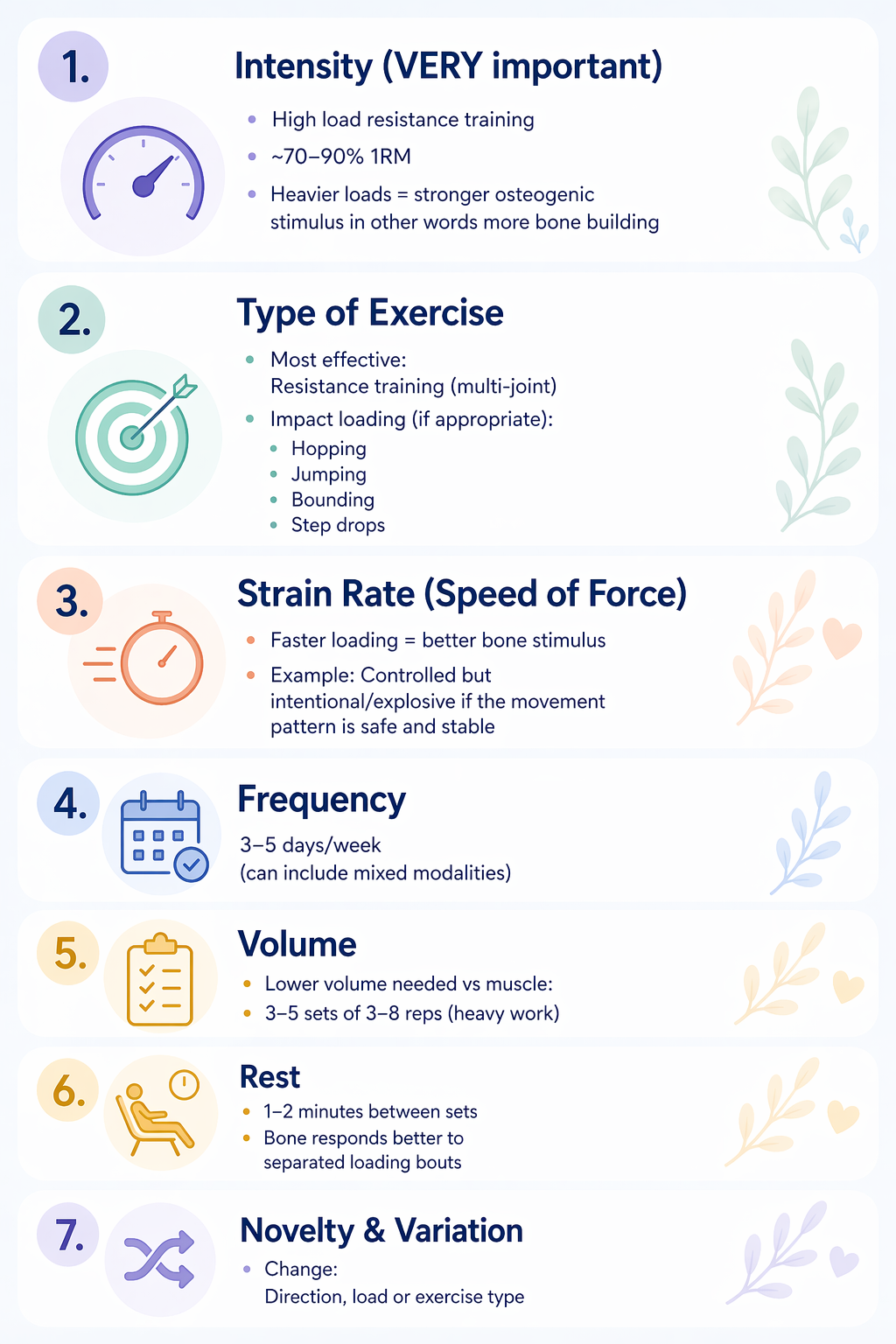
Believe it or not, bone responds differently than muscle.
Bones need load + impact + novelty!
🔑 KEY TAKE HOME: BONE BECOMES DESENSITIZED QUICKLY TO REPETITIVE LOADING; HENCE BONES LIKE CHANGE.
A strength based exercise program might look different than a bone building program. Hence at the cancer physio, we design your rehab personalized to your diagnosis and goals. If you have bone metastasis for example, exercise will be different than if your goal is to prevent bone mineral density loss.
If you’d like support with a bone building program, consider personalized cancer rehab with the cancer physio.
*Before starting any strength or bone building program please consider the following:
⚠️ Important Clinical Considerations (Cancer/Osteoporosis)
Avoid repetitive spinal flexion/twisting with load when with osteoporosis
Monitor fatigue
Modify impact/load if with Bone Metastasis or if you are a high Fracture Risk
Always consider our Safe Cancer + Exercise Guidelines
✦ SAMPLE BONE BUILDING EXERCISE PROGRAM ✦
Goal: Maintain or improve bone mineral density
Frequency: 3x per week building to 5x
Style: Slow, progressing to faster speeds or more weight
Strength Training (ordered in easy-harder)
Sit-to-stands, squats, weighted squats 50% 1 RM or jumping
4 sets of 8 reps, aim to decrease to 6 reps over time
Step-ups, lunges, weighted 50% 1 RM or jumping
4 sets of 8 reps, aim to decrease to 6 reps over time
Banded rows or chest press, weighted
Weight-Bearing Movement (Daily Life Counts!)
Walking (bonus: Victoria’s trails + hills)
Stairs
Light hiking
Optional Impact (If Safe for You*)
Step hops
Gentle jumping, skipping rope
Low-level bounding
Nutrition to Support Your Bones
Think of nutrition as your foundation and consider nutritional guidance from a registered dietician at BC Cancer if you are in need of more support. Simple, steady habits make a big difference here.
Focus on:
Calcium (food first where possible)
Vitamin D (often needed in BC)
Protein (to support muscle and bone); some guidelines recommend 0.75-1g/lb of body weight
Monitoring Bone Health in BC
Keeping an eye on your bone health allows for preparedness. You may not be offered a bone mineral density scan due to the long waitlists; but I strongly encourage you to obtain a baseline before you start hormone therapy.
CONSIDER THIS BMD SURVEILLANCE PLAN:
Bone Scan (gold standard measurements of BMD and osteoporosis risk)
Baseline DXA scan (although it is not gold standard, it is a decent marker of change)
Follow-up scans (often yearly)
Ongoing discussion with your care team
Bringing It All Together
Supporting your bone mineral density while on hormone therapy doesn’t need to feel overwhelming, habits take time and can be hard.
Start with:
Gentle, consistent exercise considering the principles mentioned above
Simple nutrition habits
Regular monitoring
And build from there.
Thank you for your interest in science and rehab.
Kindly, The Cancer Physio

A Note from The Cancer Physio:
With an aims to curate the latest science, and provide evidence rich tools, I think it is important to understand that not all questions can be answered and good science seeks to provide more questioning over time. I urge you to shy away from sweeping statements and soap box leaders with strong claims. Often new science is just around the corner.
Social media is full of ‘experts’ without credentials. There advice may be harmful. Please be careful.
On the other hand, often patients have been told a lot of ‘don’t statements’ through-out their journey; at times mitigating risk is important but one must always ask at what cost.
Every phase of treatment is unique and there for every new intervention is a personal decision.
Informed decision making = informed risk + possibility.
My ask is that you ask good questions too, as much as possible and keep them coming. One person’s story may have a lot of impact but probabilities are important too.
Unfortunately, there will not always be an obvious answer, but…
In the unknown try to remain curious, hopeful and even optimistic.
Keep the boundaries open a bit; you might just be a little surprised.
References (2019–Present)
Hadji P, et al. Management of Aromatase Inhibitor-Associated Bone Loss, 2023–2025 updates.
International Osteoporosis Foundation. AIBL Position Statement, 2023–2025.
RACGP Osteoporosis Guidelines – AI-induced bone loss.
Shapiro CL, et al. Endocrine therapy and bone health in breast cancer, 2023.
Coleman R, et al. ESMO Clinical Practice Guidelines, 2020.
Khan AA, et al. Exercise and osteoporosis reviews, 2019–2023.
